⚠︎ Risk warning: leveraged derivatives on unregulated platforms — you can lose everything you deposit. Not investment advice.
Hyperliquid Outcome Markets (HIP-4): Prediction-Style Trading
All mechanics on this page were re-verified against Hyperliquid's official documentation,
and what is live against its public outcomeMeta endpoint, on 2026-10-07.
Details the docs don't state are flagged as unverified rather than filled in.
Outcome markets are Hyperliquid's newest contract type — defined by HIP-4, the proposal that followed HIP-3's builder-deployed perps. They are prediction-market-style instruments: instead of tracking a price continuously the way a perp does, an outcome contract asks a question with a fixed resolution — and settles once, at a known time, to one side or the other.
What an Outcome Contract Is
Hyperliquid's docs define outcomes as "fully collateralized contracts that settle within a fixed range" and describe HIP-4 as "a general-purpose primitive that is useful for applications such as prediction markets and bounded options-like instruments." In the binary case you buy either the Yes side or the No side of a stated proposition. At settlement, the correct side converts to the full unit of collateral and the incorrect side to zero: priced between 0 and 1 while trading, worth exactly 1 or 0 when resolved.
"Fully collateralized" is the structural difference from everything else on this site: positions are backed in full, and per the official docs, outcome trading "does not involve leverage or liquidations." There is also no funding — funding exists to anchor perpetuals that never expire, and outcomes expire by design. If you've read our perpetuals explainer, the contrast is clean: an outcome position can't be liquidated, costs nothing to hold, and the most it can lose is what you paid for it.
One Book, Two Sides
A design detail worth understanding before trading: the Yes and No order books for the
same outcome are merged. Per the docs, "an order to buy Yes at price p is
equivalent to an order to sell No at price 1-p" — so both sides share one
pool of liquidity, and the Yes price plus the No price always describes the same market.
The price of Yes reads naturally as the market's implied probability of the event.
The docs also define "Questions": collections of outcomes where exactly one settles Yes
and the rest settle No. The HIP-4 page still says multi-outcome markets "are not part of
the initial mainnet release", but mainnet has moved past it: on 7 October 2026 the
outcomeMeta endpoint listed 29 questions, among them season winners for the
Premier League, Champions League, NFL and MLB, individual match results, an award winner
and the Federal Reserve's October 2026 rate decision.
How Settlement Works
The first live market type is a recurring binary outcome that, per the docs, "settles daily at 06:00 UTC to the BTC mark price on HyperCore mark prices" — a daily will-BTC-be-above-this-price question. On 7 October 2026 the same daily series ran for BTC, ETH, SOL and HYPE. The contract specifications also define a "Multi-price" recurring type with three price buckets, exactly one of which settles to 1, and a daily BTC question of that type was listed the same day — the protocol's own multi-outcome market. Resolution for these price markets is mechanical, not human-judged: the settlement price is computed by interpolating the platform's own mark-price feed at the settlement timestamp, and the contract settles Yes if that value is at or above the target. Recurring outcomes are "automatically deployed and settled by the protocol on a fixed cadence" — no market creator decides the result.
That trust property covers only the protocol's own recurring price markets. Every
sports, award and rate-decision question listed on 7 October came from a third-party
deployer (26 from the out venue, 2 from trade[XYZ]'s txyz), built
on a validator-approved template that names the official source or awarding body and a
resolution or decision deadline, and settled by that deployer submitting the result. One of
them, trade[XYZ], spells out what that means in its
Terms: Hyperliquid "applies authorized settlement
actions onchain. Its acceptance of an action confirms onchain authorization, not the
accuracy of offchain information or the correct application of the Event Rules", and
"Unless the Event Rules expressly provide otherwise, there is no formal outcome challenge
or appeal process." For a non-price market, read the deployer's own rules before trading.
Fees
Per the HIP-4 page, fees are "currently zero for outcome markets for initial testing." Per the fee docs, when charged, outcome-market fees apply only when closing or settling a position, not when opening one, and outcome trading doesn't pay maker rebates — users who'd earn rebates on perps or spot pay zero on maker orders instead. "Currently" is doing real work in that sentence: treat zero fees as a testing-phase state, not a permanent feature.
What We Couldn't Verify
The docs still carry no launch date for the mainnet release. They now do describe
third-party deployment: "validators vote on outcome templates, which HIP-4 deployers use as
the basis for permissionless deployments", deployers must keep a staking requirement for as
long as they deploy, and they cannot deactivate before "the minimum deployer staking duration
(183 days) has elapsed". Two gaps remain. That page is labelled "Testnet-only", yet mainnet's
outcomeMeta on 7 October 2026 already listed three deployer venues —
out (165 outcomes), txyz (trade[XYZ], 64) and skew
(61) — beside eight protocol-run recurring outcomes (the four daily price binaries and the
four outcomes of the daily BTC multi-price question). And the page does not state the
mainnet stake amount or limits (on testnet: at most 10 active outcomes and 50 deployments a
day per deployer), so we don't quote one.
What It Looks Like
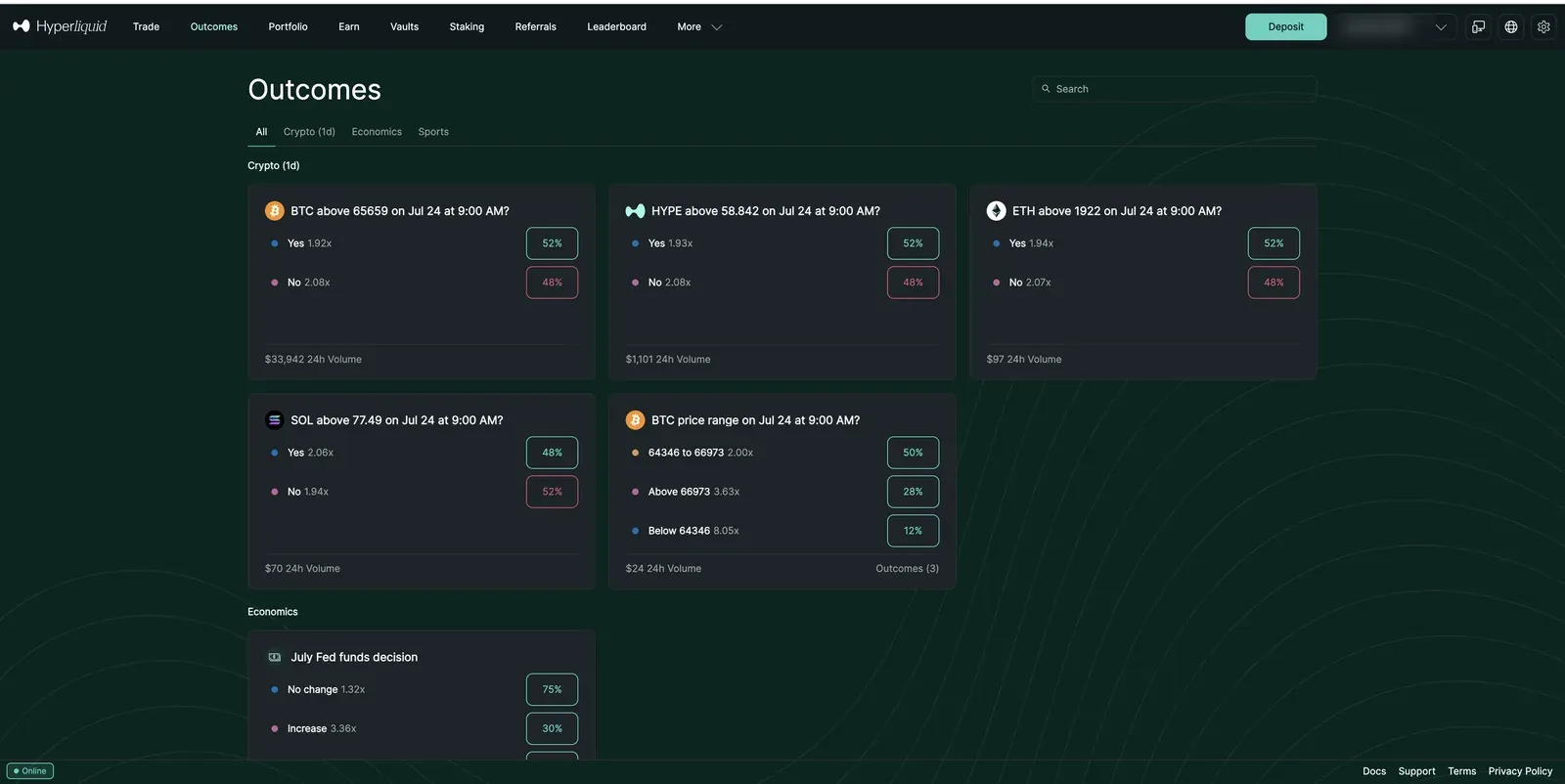
The Outcomes tab on our own account (captured 2026-07-23): each card is one question, the percentages are the market's implied probabilities, and the multiples (like "1.92x") are what a correct $1 position returns at settlement. Alongside the daily crypto price markets, an economics category was live — a July Fed funds decision market — an early sign of the third-party, non-price markets that were live by October (see above).
Where to Find Them, and What to Read Next
Outcome markets have their own section in the Hyperliquid app — an "Outcomes" tab sits in the main navigation alongside Trade and Vaults (observed in the live app on 2026-07-21). For the venue itself, start with our Hyperliquid review and how-to-start guide.
Outcome markets are Hyperliquid's entry into territory that prediction-market platforms have occupied for years — and the wider prediction-market world, including the regulated exchanges that dominate it, is its own subject. Our sister site PredictorHQ covers that landscape — how prediction markets work, who the platforms are, and how the regulated venues compare — and is the right starting point for prediction markets as an asset class rather than as one venue's feature.
Frequently Asked Questions
Can I be liquidated on an outcome position?
No. Per the official docs, outcome trading doesn't involve leverage or liquidations — positions are fully collateralized. The maximum loss is the amount you paid for your side of the contract, realized if it settles against you.
Is this the same as betting on Polymarket or Kalshi?
The instrument shape is similar — contracts that settle 1 or 0 — and by October 2026 Hyperliquid also listed sports, award and rate-decision markets. The difference is who resolves them: the protocol's recurring price markets settle automatically from its own price feed, while every non-price market is settled by the third-party deployer that listed it, under that deployer's rules, traded from a self-custody wallet. The broader comparison across prediction-market platforms is PredictorHQ's territory.
Do outcome positions cost anything to hold?
No funding applies — that's a perp mechanism. Fees are currently zero during initial testing, and when charged they apply at close or settlement, not at open, per the official fee schedule.